“No, but it’s consistent.”

The movie _What’s Up Doc_, the 1972 romcom with Barbara Streisand and Ryan O’Neal, has a scene near the end where a giant group of characters are in front of a very unamused judge. In the midst of an explanation, Dr. Howard Bannister asks “Is that clear?” To which the long-suffering judge replies “No, but it’s consistent.” I’m sure you have many lines from movies that come up as familial or friendly touchpoints–ways to keep connected on an idea in fun and meaninful ways. This was one of ours…”No, but it’s consistent.”

I’ve been thinking about consistency a lot lately. In conversation, I’ve reassured folks I care about that a behavior by someone else is not just directed at them, but an indicator of how that person is with everyone. Does it make sense always? No. But is it probably consistent? Yep. That’s not necessarily a bad thing, though. I hope to always be as consistently me as possible.

When in grief and heartache, I lean toward creation and connection. I hope not to dull my senses or avoid feelings, but to sit with them. Golly, that’s really not fun, but I’ve gotten good practice in the last four years. It’s not just in sorrow that I hope to be consistent, though. It’s also in my joy, the way I love full-tilt, heart on my sleeve, no reservations, all the way in. I don’t want to change that even if the side-effects aren’t always great. I don’t want experiences or circumstances to change my consistency or me. “Don’t go dark on me, Bob.”

Am I going to find the dirty joke in an inappropriate setting? Am I going to share what I have? Am I going to paint and dance in the kitchen and sob my eyes out and tell my sunflower “thank you for being beautiful?” Am I going to try to look at things from someone else’s perspective, to understand, to extend grace? Am I going to be occasionally thoughtless or careless with words or actions because I’m in a hurry or not fully thinking through the consequences? Yes to all of it. And when I lose, I also try not to lose the lesson.

[If you enjoy what you read here, you’re welcome to buy me a coffee or contribute to the paint fund here: https://venmo.com/u/FerylGal_1 ]
Aunt Becci’s Mean Dip

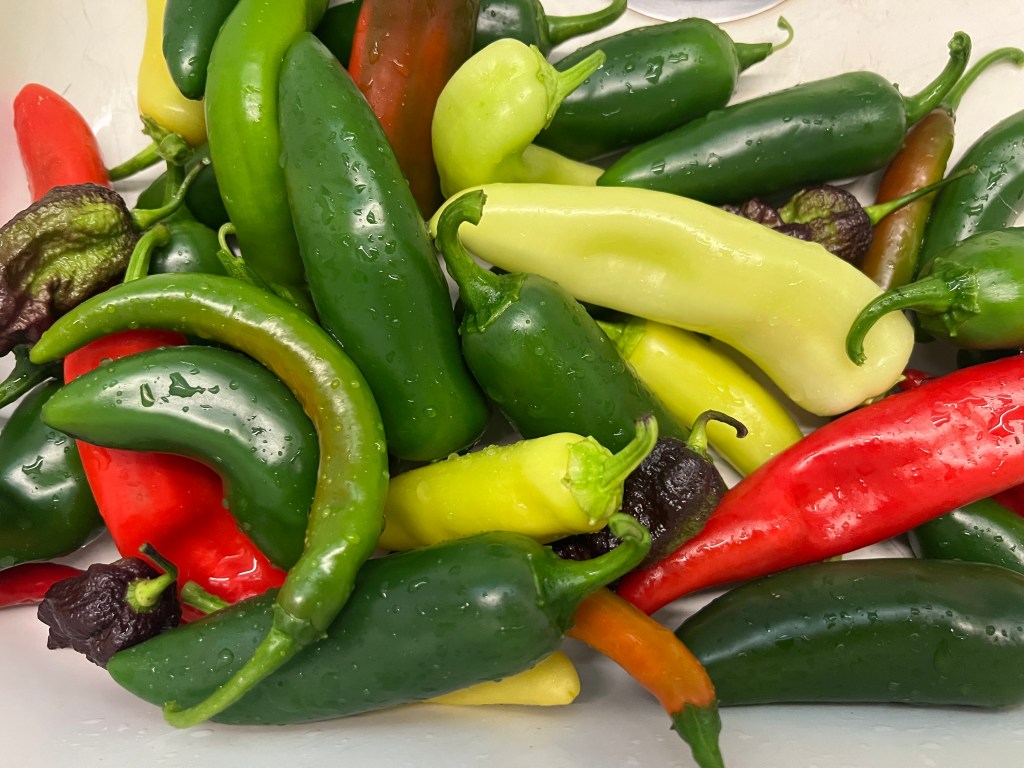
It’s time to share one of my most favorite things to make at the end of summer–“Mean Dip.” I always like to grow a variety of peppers from mild bell to some version of atomic-devil-death. Jalapenos definitely get pride of place as I find them to be the superior pepper. I ususally grow two or three plants. I also have Hungarian Wax, Pablanos, Cayenne, Anaheim, and something this year called Purple Death. I’ve been sharing here and there with neighbors and friends as the plants have been putting on fruit, but by September, I’m able to do a big harvest. Yesterday, I got enough to make a big batch of Mean Dip.

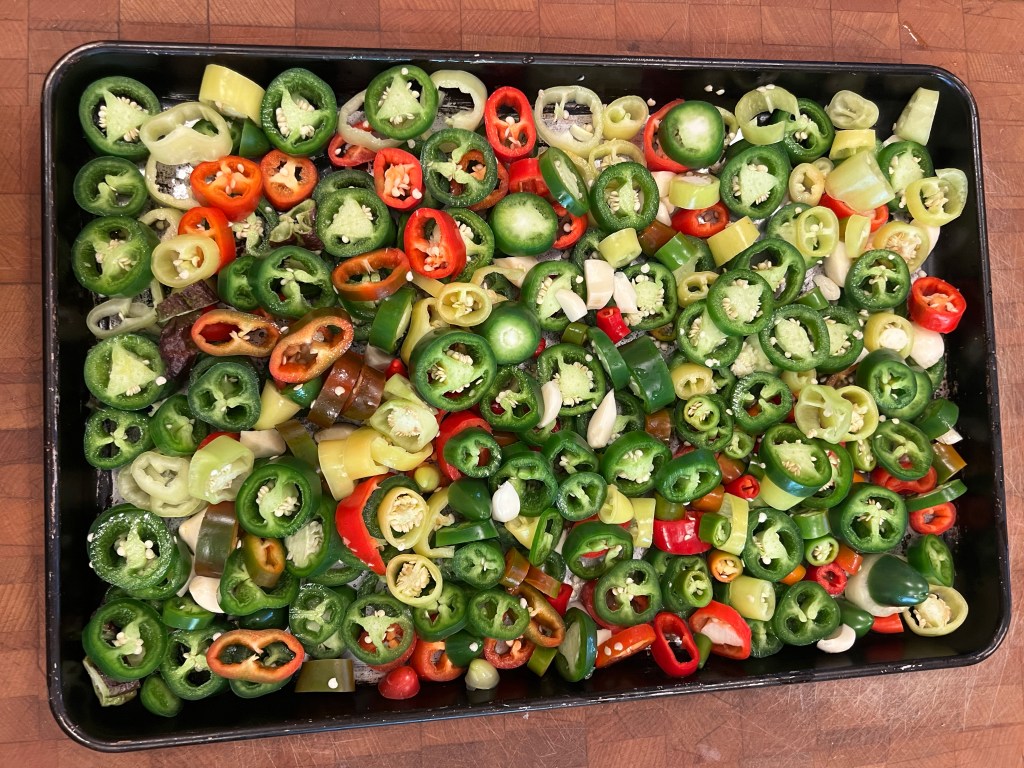
First step preheat the oven to 400 degrees F. Get a baking sheet and drizzle olive oil all over. Next, slice up all your peppers, the more seeds and the hotter the peppers, the meaner the dip. I also do one full bulb of garlic, peeled and each clove halved. I make sure the pan is thickly covered with the peppers and garlic and I top with a little more olive oil and some ground cumin.

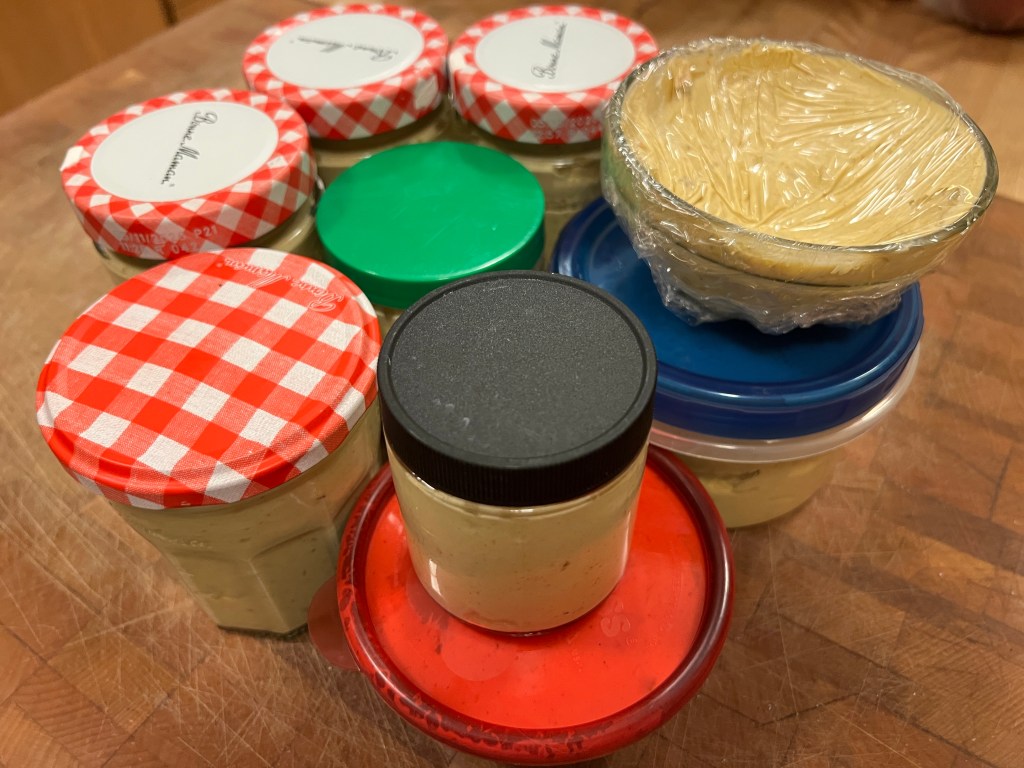
Then I bake these beauties for 25 minutes. Once they’re out of the oven, I put them into a food processor and blend with a little more olive oil, some red wine vinegar, and salt & pepper. Don’t ask me how much, I eyeball it. Do what looks good. Once it’s fully blended, I take it all out and then use about 1/4-1/3 c of the pepper blend to one brick of cream cheese. I ended up with four cups of the pepper blend and ended up mixing it a little at a time with eight bricks of cream cheese.

This isn’t the meanest of the Mean Dips I’ve ever made, and I suspect the next round will have a couple more of the Purple Death peppers. This round only had one. My nephew, Brennan, said it could be meaner. Mary, my kiddo, called it “Spicy Nice.” I can tell you this though, it’s addictive and ridiculously delicious. Eat it with tortilla chips, crackers, cut veggies, anything you can think of.

There’s a reason I only make this once a year.

Lucky

Bryan often spoke about how lucky he felt largely due to the relationships and people in his life. Bryan had plenty he could have complained about–a cancer diagnosis at 50 that he managed with grace and aplomb, another one at 58 that would give him less than five months to live. Even so, he practiced gratitude, particularly with regard to his daughter and wife, his friends, his healthcare providers, the quality of the pork chop served by the hospital kitchen at St. Mary’s. I’ve never heard anyone wax lyrical about hospital food, but he sure did. Bryan was lucky to be surrounded by so much love, but he fostered that in his confidence, his ability to know himself fully in order to put everyone else around him at ease.

I find myself trying to emulate his practice. The more I notice how lucky I am, the luckier I seem to get. In the past two weeks, especially, I’m reminded how the people in my life make me lucky in a similar manner. I have friendships, durable relationships that have lasted decades–friends who have known me since first grade, or middle school, or the whole time I’ve lived in Walla Walla (18 years this month, can you even?!) They have seen me at my best and unfortunately at my very worst (yes I did flip cold French fries off a plate in a fit of pique/temper…I’m not proud of it, but it’s funny to tease me about. And don’t get me started with what happens if I forget to eat breakfast). They span continents and time zones, which makes these middle-of-the-night musings welcome in Australia or to my bestie who works the night shift a few time zones away.

When someone doesn’t believe me, they’re all ready to line up and give testimonials of my character. More importantly, they remind me of myself, giving ME testimonials of how they see me, my heart, my intentions. It’s never fun to have the worst believed of you or to be painted with a brush meant for someone else, but at the end of the day, that’s not my business. What is my business is to tend this garden of friendships, of durable relationships because they’re the ones that see me through when my heart aches, when my person is dying, when the world is on fire. I am lucky because they see me and love me.

Resolving the Chord

In (tonal–I should be specific since I’m not an expert) music theory, there is a home chord that sets the basis for the piece/movement in a particular key. This is where things are stable, at rest. The music needs to have tension to be interesting, but the resolution back to that home chord gives a sense of release and relief. The complexity of this dynamic gives music drama, intrigue, a reason to listen. Am I painting with a very broad, novice’s brush, yes, yes I am. That’s okay, it’s my blog and I’ll write how I want to.

Life is less like a 3-minute rock song with obvious chord progressions and resolutions–tension followed by relief–and more like a jazz jam session with amateurs. We have an idea of what’s going on, we may know some of the chords, but we’re kind of doing our own solo hoping for the best, and sometimes it sounds great and sometimes it sounds like hell.

We don’t always get the relief of the chord resolution. What happens next? Is the problem fixed? What do they think of me? What did I do wrong? Will the villain get punished? Will the aggrieved get justice? Do the good guys win in the end? Bryan often used to say that “we’re not in control of the outcome.” I think of that so often and he was right. We’re not. We do our best. We play the notes we know as well as we can and then hope things turn out. Sometimes they do. Sometimes they don’t. And sometimes, we don’t get to know the outcome at all. It doesn’t make the longing for resolution go away, but with time and wisdom, perhaps we can let it go and just enjoy the music for what it is. Maybe we find our own home chord and go back there when the tension is too high–nature, prayer, communing with friends, creation, gratitude. Those are my home chords. What are yours?

Kintsugi

When I was a little girl in one of our houses in Yakima, I remember jump-roping in the living room. My delight and play turned to chagrin when the rope looped around a porcelain figurine of bright red cardinals, a treasure my mom cherished because it reminded her of seeing those beautiful birds in Ohio. The look of horror, sorrow, and anger on her face still haunt me to this day. I didn’t mean to break anything, least of all this prize possession, but my intent didn’t matter when the damage was done. Unfortunately, there was no possibility for restoration with superglue or gold dust. I had to acknowledge that my carelessness hurt her and broke something irreplaceable. It’s a tough lesson to learn when you’re six. It continues to be a tough lesson no matter the age. Fortunately, my mom didn’t ever hold a grudge on that score. I just wasn’t allowed to jump rope inside the house anymore.

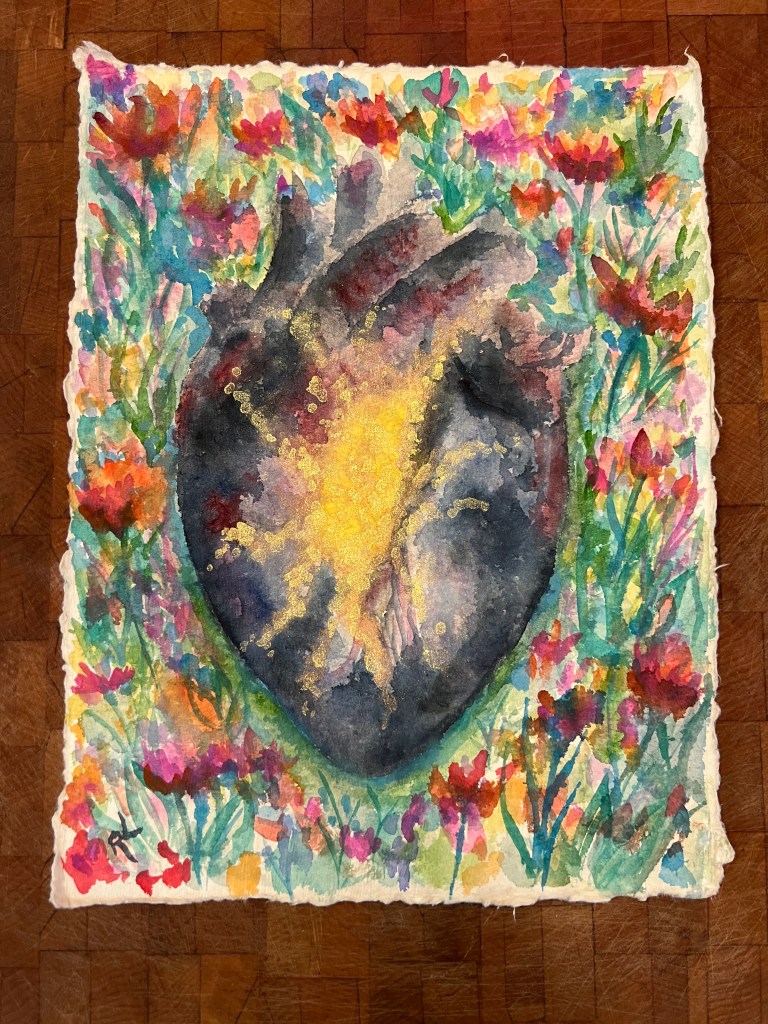
Kintsugi, the traditional Japanese technique and art for fixing broken pottery gives me a little bit of hope. (Go with me on this metaphor, pretty please.) In this tradition, pottery is mended with a lacquer dusted with powdered gold. The effect is extraordinary. The broken part is no longer something to be hidden or even grieved, but the repair turns the whole piece into something completely new and beautiful. Perhaps it is so when we work through hurt caused by careless words or actions. Maybe grace and joy, and most of all love, are the kintsugi gold to our hearts.